Vietnam's craft villages: where things are still made by hand
Vietnam has special places — whole villages where almost every family has practised the same craft for generations. In one they spin the potter's wheel, in another they weave silk, glue lanterns or roll incense. These 'craft villages' (làng nghề in Vietnamese) have become both keepers of tradition and a magnet for tourists. Here are the most beautiful of them, and what you can bring home.
What a 'craft village' is
A craft village is a settlement where almost all the inhabitants live by a single trade: shaping pottery, weaving cloth, carving wood or making paper. The secrets of the craft are passed from father to son over centuries, and the trade itself becomes the 'surname' of the whole village.
There are thousands of such villages in Vietnam — especially around Hanoi and in the Red River Delta. Many are 500 to 1,000 years old and still working today. Tourism has now been added to the traditional income: visitors come to watch, try making something by hand and buy it straight from the maker.
Bat Trang: a kingdom of pottery
Bat Trang, near Hanoi, is the country's most famous pottery village, about 600 years old. It sits on the bank of the Red River, and for centuries local clay has been turned here into vases, cups and figurines with a signature deep glaze and blue-and-white patterns.
Today Bat Trang is a huge ceramics market and dozens of family workshops. Tourists are invited to sit at the potter's wheel and shape their own cup, then take it home. People bring back tableware, tea sets and souvenirs — cheaply and from the makers themselves.
Van Phuc: a thousand years of silk
The village of Van Phuc in the Ha Dong district has been weaving silk for over a thousand years. Its fabrics were once worn at the imperial court, and today fine scarves, shawls and cloth for ao dai dresses are still made here on old wooden looms.
Van Phuc is worth a stroll if only for the lane hung with silk of every colour. Here you can see the whole process — from the silkworm's cocoon to the finished fabric — and buy real Vietnamese silk directly, without the shop mark-up.
Hoi An's lanterns and Kim Bong carving
The old town of Hoi An in central Vietnam is famous for its silk lanterns: in the evening thousands of coloured lights turn the streets into a fairy tale. Many workshops run short classes where you can assemble your own lantern and take it with you.
Nearby, across the Thu Bon River, lies the village of Kim Bong — where people have carved wood for five centuries, blending Vietnamese, Chinese, Japanese and Cham motifs. And close by, in Thanh Ha, they shape terracotta pottery. Together they make the area around Hoi An a real open-air museum of crafts.
Quang Phu Cau: the incense village
The village of Quang Phu Cau near Hanoi has made incense for centuries — the aromatic sticks for temples and home altars. It became famous thanks to photographers: bundles of sticks are dried in the sun, fanned out into huge red-and-pink 'bouquets'.
These scarlet bursts have become one of the most recognisable images of Vietnam on social media. Tourists are drawn here precisely for the bright shots — and, along the way, to watch the sticks being rolled by hand and buy fragrant sets.
The conical-hat village of Chuong
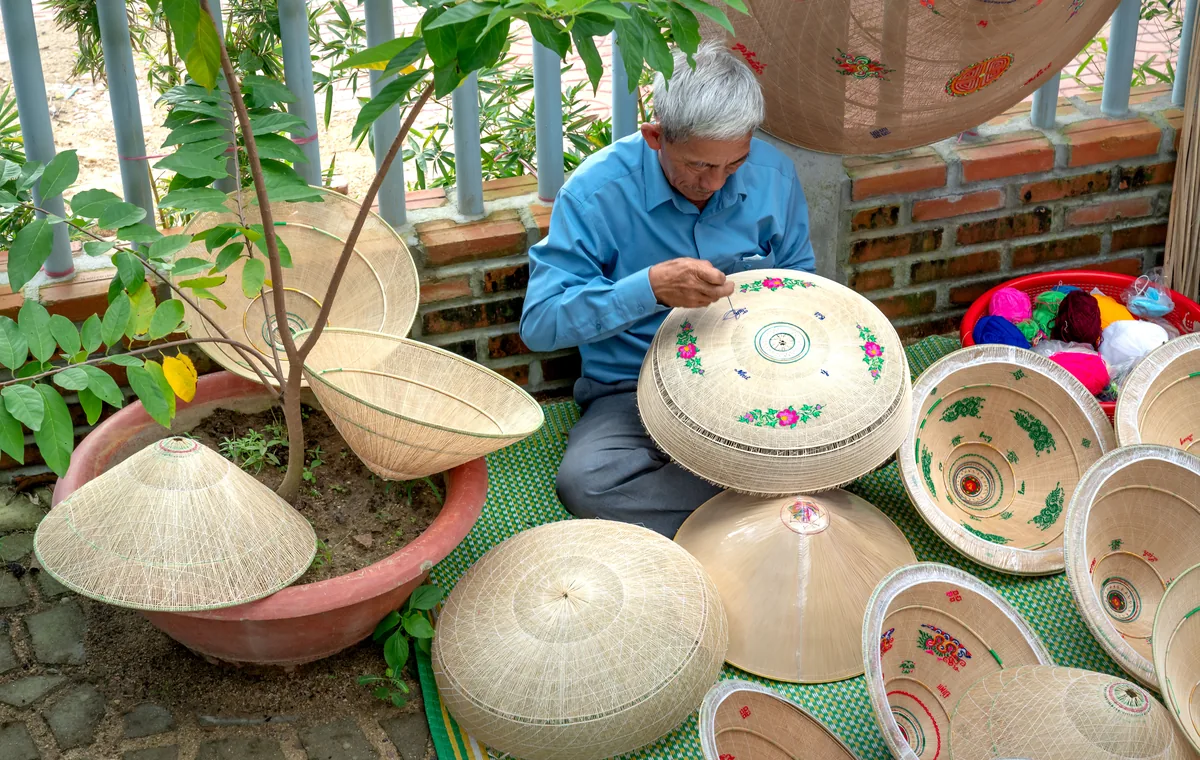
The conical hat, nón lá, is a symbol of Vietnam, and one of its main 'homes' is the village of Chuong near Hanoi, which has woven hats for centuries. From palm leaves and a bamboo frame, the makers hand-assemble the very headgear that shields you from sun and rain.
At the local market the hats lie in whole white hills. Visitors are shown how, leaf by leaf, a nón lá is born, and are offered to paint or decorate their own — a light and very 'Vietnamese' souvenir.
Dong Ho paintings and other crafts
Vietnam's crafts don't end with pottery and silk. In the village of Dong Ho, folk pictures have been printed from wooden blocks for centuries — bright prints hung up for the Tet New Year. In Dai Bai and Phuoc Kieu they cast bronze — gongs, bells and figurines.
There are villages for weaving bamboo and rattan, mats, making do paper, and carving stone and wood. Almost every region has its own signature craft, and together they form a vast map of Vietnamese handiwork.
Why tourists go to these villages
The main reason is to see a thing born by hand rather than rolling off a conveyor belt. The villages run hands-on classes: you can sit at the potter's wheel, assemble a lantern, roll incense or weave a hat — and take the result with you.
The second reason is shopping. The same item costs less here than in tourist shops, and the money goes straight to the maker. You end up with an honest souvenir that has a story, not a faceless fridge magnet.
Why crafts matter to Vietnam
Craft villages are not just pretty pictures. They feed hundreds of thousands of families, preserve skills that are thousands of years old and support whole regions. That's why both the state and the residents themselves try to protect and develop them.
It isn't easy for the artisans, though: factory goods are cheaper, and the young leave for the cities. Tourism and the interest of visitors from around the world are exactly what help these villages keep going — every purchase supports a maker and their family.
What to bring home and how to get there
From the villages people bring pottery and tea sets (Bat Trang), silk scarves and shawls (Van Phuc), lanterns (Hoi An), incense (Quang Phu Cau), woven hats and baskets. All of it light, inexpensive and with a real story.
The villages near Hanoi are easy to do as a day trip — many tour companies take you to three or four places with hands-on classes at once. In central Vietnam, crafts are easiest to see from Hoi An. Just haggle calmly and buy from the makers themselves.
What it means for a visitor to Nha Trang
Even if you're holidaying in Nha Trang, you can see crafts at the local markets and souvenir lanes, and for the real villages take a trip to central Vietnam — to Hoi An, for example. Handmade work is the best way to bring home a piece of the real Vietnam.
And if you'd like to delight a loved one, partner or friend right here and now — we'll deliver a fresh bouquet or helium balloons to a hotel, villa or office from the next day. Message us on WhatsApp, Telegram or KakaoTalk.